Problem Set 2
MSE 212/ME225 Spring 1999
Prof. Ritchie
You and your friends are at a party, having a good time. One of your friends announces that she just got engaged, and shows you a massive diamond ring. After congratulations are given, another friend also announces an engagement and shows off her new ring. While comparing rings the two women simultaneously slip and fall, and both rings strike the coffee table on the way down. The diamond in one of the rings shatters.
#1. Case 1 -- It turns out one of the rings had a semi-elliptical shaped flaw. How big must the flaw be to lead to fracture if we consider the diamond to be a rectangle (shown in the drawing) and the load of striking the coffee table can be modeled as a moment (shown below)? Assume the location of the semi-elliptical flaw is at the outer edge of the rectangle.
#2. Case 2 – It turns out one of the rings is actually not a real diamond but a fake (cubic zirconia). Assuming that both rings have the same geometry and are subjected to the same load (as shown for #1), and both have identical flaws, which one fractures first? Why?
#3. In Case 2, what are the energy release rates of the two rings? How does this correspond to the critical stress intensity and the failure of the rings?
#4. What is the stress state at the crack tip (for Case 2) qualitatively (draw picture/graph)? Quantitatively describe the stress state (including T-stress if applicable).
#5. If you were to assume that the flaw in Case 2 was oriented at an angle of 45 degrees (see drawing), would that change the fracture of the ring? If so, how?
#6. Do you believe that your answers are conservative, or not?
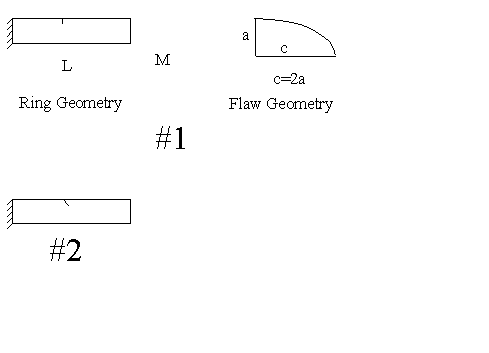
Width (2W) = 0.5 in
Depth (t) = 0.25 in
Moment (M) = 50 in lbs
Young's modulus: E (diamond) = 150 x 106 psi; E (Zr2O3) = 20 x 106 psi
Fracture toughness: KIc (diamond) = 7 MPa m½; KIc (Zr2O3) = 3 MPa m½