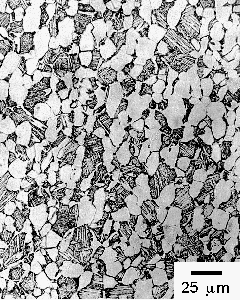
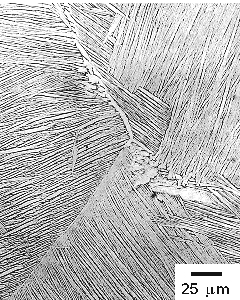
a) Bi-modal b) Lamellar
O. RODER, J. O. PETERS, A. W. THOMPSON, and R. O. RITCHIE
University of California at Berkeley
Department of Materials Science and Mineral Engineering
Berkeley, CA 94720-1760
Introduction
The ingestion of foreign objects into jet engines powering military
or civil aircraft can lead to severe structural damage of the fan and compressor
airfoils; indeed, such foreign object damage (FOD) is a prime reason for
maintenance and repair. In particular, the damage induced by small hard
objects of millimeter size, in association with the typical load spectra
experienced by airfoils, i.e., low-cycle fatigue (LCF) cycling due to normal
start/flight/landing cycles superimposed with high-cycle fatigue (HCF)
cycles due to vibrations and resonant loads, can lead to non-conservative
life prediction and unexpected high-cycle fatigue failures. Specifically,
the damage sites can provide initiation points for cracks, which then propagate
under the HCF spectra of large numbers (>109) of high frequency
(>1 kHz), high load-ratio (R ~ 0.8) cycles. The objective of this
study was to characterize (i) the size and shape of the indents and (ii)
the level of microstructural damage induced by impacts of foreign objects,
(iii) to examine the influence of foreign object damage on crack initiation
and crack propagation that can lead to failure by HCF and (iv) how that
crack propagation behavior is affected by microstructure. The primary study
was performed on a fan/compressor blade processed (STOA) bi-modal microstructure
of the titanium alloy Ti-6Al-4V. In addition, a b-annealed
lamellar microstructure was investigated to isolate the role of microstructure.
Material, Microstructures and Tensile Properties
The titanium Ti-6Al-4V alloy studied was delivered as a solution treated and overaged (STOA) forged plate. The plate came from a set of forgings produced specifically for the U.S. Air Force sponsored programs on HCF. Material and processing details are given in [1]. The plate material showed a bi-modal microstructure with a volume fraction of 60 % primary a (diameter ~20 mm) and 40 % lamellar a+b matrix (Figure 1a). In addition to the bi-modal microstructure, a b-annealed lamellar microstructure (Figure 1b) was investigated for comparison. To obtain a lamellar microstructure, the delivered plate material was solution treated in the b phase field at 1005° C for 10 min. This b-annealing resulted in large b grains with a diameter of approximately 1000 mm. Controlled cooling with a rate of 100-130° C/ min to match the same lamellae width of the bi-modal microstructure (2 mm) resulted in a a+b lamellae colony size of 500 mm. Finally, to ensure comparability with the bi-modal microstructure, the lamellar microstructure was given the same final heat treatment step of 2 h at 705° C.
The uniaxial tensile properties of both bi-modal and lamellar microstructures are listed in Table 1:
Table 1: Tensile properties (strain rate 5 x 10⁻⁴ s-1)
| Condition | s0.2 (MPa) | UTS (MPa) | El. (%) |
| Bi-modal [1] | 930 | 970 | 20 |
| Lamellar | 975 | 1055 | 12 |
Simulation and Characterization of Foreign Object Damage
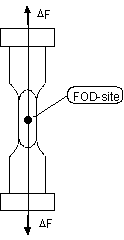
Foreign object damage by hard particles is simulated by firing chrome-hardened steel spheres on a flat specimen surface by using compressed gas to produce a single damage site. [2] The specimen geometry chosen for this study has a rectangular gauge section (3mm ´ 5mm) with cylindrical buttonhead grip sections (Figure 2). To provide a consistent, nominally stress-free surface, the gauge section was prepared by standard stress relief and chemical-milling procedures. In this study, spheres (diameter 3.175 mm) were impacted at an angle of 90º (normal impact) at velocities of ~200, 250 and 300 m/s. These velocities were chosen because (i) they represented typical in-service impact velocities on blades, and (ii) they provided different levels of damage (see below). Damage sites have been characterized to date in terms of the geometrical dimensions (shape, diameter, depth) and microstructural changes.
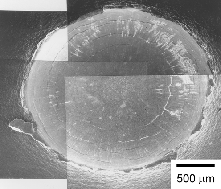
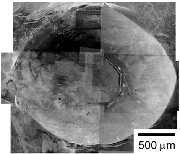
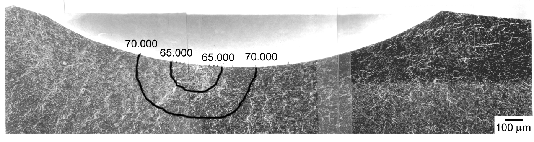
SEM micrographs of typical impact sites for the bi-modal microstructure
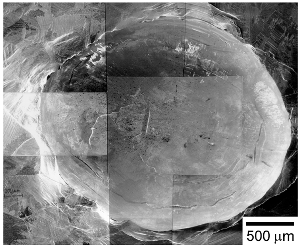
are shown in Figure 3a (200 m/s) and Figure 3b (300 m/s). For the lamellar
microstructure typical impact sites are shown in Figure 4a (200 m/s) and
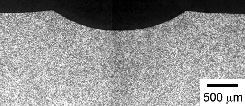
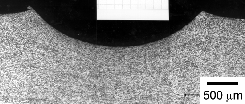
Figure 4b (250 m/s). For the bi-modal microstructure, corresponding cross
sections of impact craters are shown in Figure 5a (200 m/s) and Figure
5b (300 m/s). While at 300 m/s (Figure 5b) and 250 m/s, tangential orientated
shear bands (Figure 6) were seen emanating from the surface of the crater,
such shear bands were not observed for 200 m/s impacts (Figure 5a). This
result corresponds with the reported critical velocity of 214 +/-16 m/s
to achieve shear bands in Ti-6Al-4V by an impacting 3.2 mm diameter steel
sphere [4]. The amount and length of the observed shear bands increased
with increasing impact velocity. In addition, the 300 m/s impacts caused
a ridging along the crater rim (Figures 5b and 6b); this feature was not
seen for the lower velocity impacts (Figure 5a). Figure 7 summarizes the
relevant features in form of a schematic illustration of the crater profile.
In the range of 100 to 320 m/s impact velocities, the diameter and depth
of damage site increased linearly with increasing impact velocity.
Influence of Foreign Object Damage on High-Cycle Fatigue
After impact, the tensile specimens were subsequently cycled at 20 Hz (sine wave) with a maximum nominal stress of 500 MPa at a load ratio of R = 0.1. Periodically, the specimens were removed from the test frame and examined in a scanning electron microscope (SEM) to detect crack initiation. Once a crack had initiated, subsequent crack growth was similarly monitored using periodic SEM observations. Stress intensities for the surface cracks were calculated from the Newman and Raju linear elastic solution for semi-elliptical surface cracks, assuming a half-surface length to depth ratio of 0.9 (determined from fractographic measurements). [3] In this initial study, contributions to the local stress intensity factor values from the geometry of the indentation and the residual stress field surrounding the indent have been ignored. Current studies are focused on the use of micro X-ray diffraction methods to measure such residual stresses.
The effect of the simulated foreign object damage was to markedly reduce the fatigue life compared to that obtained with an undamaged smooth-bar specimen [5], as shown in Figure 9 for the bi-modal microstructure. At maximum stresses of 500 MPa (R = 0.1), surface cracks were initiated within ~3 ´ 104 to ~5 ´ 104 cycles, the failure of the impacted specimens occurred between ~4 ´ 104 and ~8 ´ 104 cycles. Specifically, fatigue lives were reduced by over two orders of magnitude following 200 m/s and 300 m/s impacts.
For the bi-modal microstructure, crack initiation sites of the small surface cracks are shown in Figure 10a (200 m/s) and in Figure 10b (300 m/s). First results show that the cracks tended to initiate at the bottom of the indent for the lower velocity impacts and at the crater rim for the higher velocity impacts. Corresponding fracture surfaces are shown in Figure 11a (200 m/s) and Figure 11b (300 m/s). The position of the crack front during crack extension is indicated schematically (Figure 11). For the 200 m/s impact, the initiation at the bottom of the indent can be explained by stress concentration due to the notch geometry. Crack initiation at the crater rim (300 m/s) might be related to circumferential residual tensile stresses at the crater ridge [e.g. 6], which overcompensate the stress concentration effect of the indent.
The presence of the tangential orientated shear bands do not appear to play a significant role in the initiation process of the fatigue cracks. This is thought to be due to the fact that at the center of the indent, the tangential aligned shear bands are parallel to the applied stress axis.
The growth of the small cracks originating from such impact sites are compared in Figure 12 with growth-rate data for large (>5 mm) [7] and naturally-initiated small (~45-1000 mm) [5] cracks for the bi-modal microstructure. Both the naturally-initiated and FOD-initiated small-crack velocities were within the same scatter band, initially up to an order of magnitude faster than corresponding large crack results. The small-crack data tended to merge with large-crack results above DK = 10 MPaÖ m as the crack size increased. However, in the limited data collected to date, no FOD-initiated cracks have been observed in the Ti-6Al-4V bi-modal microstructure below DK = 2.9 MPaÖ m; i.e., no FOD-initiated cracking was observed below the worse-case (large crack) threshold, DKTH of 1.9 MPaÖ m, measured using constant Kmax cycling at a final R ratio of 0.95 [7] Therefore, fatigue crack propagation thresholds of large cracks determined under conditions that minimize crack closure can be used as a lower bound for the threshold stress intensities for FOD initiated cracks.
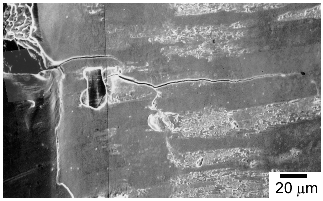
To examine the influence of microstructure in addition to the a+b processed bi-modal microstructure, a b-annealed lamellar microstructure was also investigated. A typical crack initiation site of the small surface cracks is shown in Figure 13 for an impact velocity of 200 m/s. As shown previously for the bi-modal microstructure, cracks tended to initiate at the bottom of the indent for the 200 m/s and 250 m/s velocity impacts and that the presence of the tangential orientated shear bands did not appear to play a significant role in the initiation process. Further testing at higher velocities (300 m/s) is currently underway to evaluate crack initiation at the crater ridge.
Preliminary results of fatigue crack propagation tests of the lamellar
microstructure are shown in Figure 14. It can be seen that the lamellar
microstructure showed a slightly higher resistance against the propagation
of small surface cracks as compared to the bi-modal microstructure. These
preliminary results indicate that the resistance of the impacted microstructure
against fatigue crack propagation is only minimally affected by significant
changes in the microstructural dimensions (bi-modal vs. lamellar).
Summary
This work is supported by the Air Force Office of Science and Research,
Grant No. F49620-96-1-0478, under the Multidisciplinary University Research
Initiative on "High Cycle Fatigue" to the University of California, Berkeley.
References
1. D. Eylon, "Summary of the Available Information on the Processing
of the Ti-6Al-4V HCF/LCF Program Plates", University
of Dayton Report, Dayton, OH. (1998).
2.. R. O. Ritchie, S. Suresh, J. W. Hutchinson, W. W. Milligan, A. G.
Evans, A. W. Thompson, "High-Cycle Fatigue and
Time-Dependent Failure in Metallic Alloys
For Propulsion Systems", AFOSR F49620-96-1-0478, Progress Report
(1997).
3. J. C. Newman, Jr., and I. S. Raju, Eng. Fract. Mech. 15, 185 (1981).
4. S. P. Timothy and I. M. Hutchings, in Proceedings of the 3rd
Conference on Mechanical Properties at High Rates of
Strain, The Institute of Physics, 1984, 397.5
5. J. A. Hines, J. O. Peters and G. Lütjering, "Microcrack Propagation
in Ti-6Al-4V", in Fatigue Behavior of Titanium
Alloys, R.R. Boyer, D. Eylon, J.P. Gallagher
and G. Lütjering, TMS, Warrendale, PA, 1999.
6. C.J. Studman, J.E. Field, "The Indentation of Hard Metals: The Role of Residual Stresses", J. Mater. Sci. 12, 215 (1977).
7. B. L. Boyce, J. P. Campbell, O. Roder, A. W. Thompson, W. W. Milligan,
and R. O. Ritchie, Int. J. Fatigue (1999),
accept for publication and in press.
a) Bi-modal
b) Lamellar
Fig. 1: Microstructures (LM)
Fig. 2: Specimen geometry
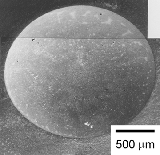
a) 200 m/s
b) 300 m/s
a) 200 m/s
b) 250 m/s
Fig. 4: Lamellar microstructure. Impact damage sites (SEM), Impact conditions:
3.2 mm steel sphere, 90º.
a) 200 m/s
b) 300 m/s
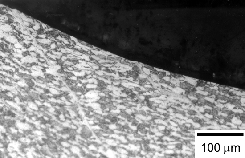
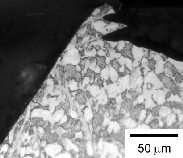
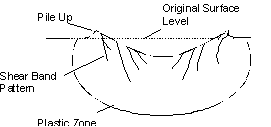
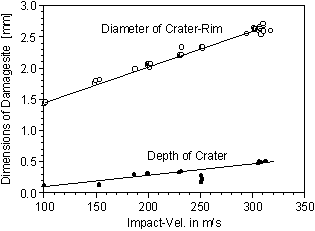
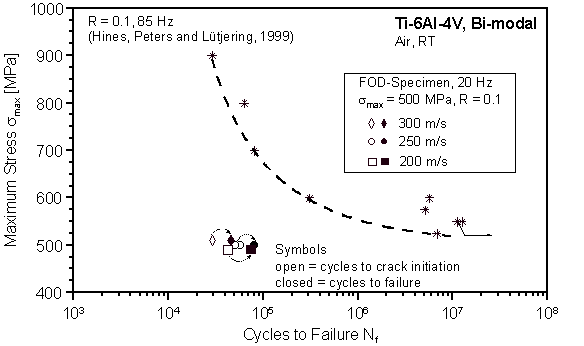
Fig. 9: Bi-modal microstructure. Influence
of FOD on fatigue behavior, compared to S-N smooth-bar fatigue data after
J.A. Hines, J.O. Peters and G. Lütjering (1999).
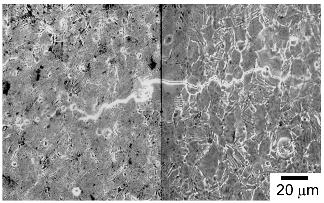
a) 200 m/s impact, N = 47.000 cycles
b) 300 m/s impact, N = 35.000 cycles
a) 250 m/s impact
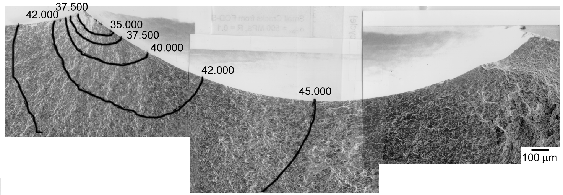
Fig. 11: Bi-modal microstructure. Fracture Surfaces (SEM), Position
of crack front as a function of number of cycles during
crack extension is shown schematically
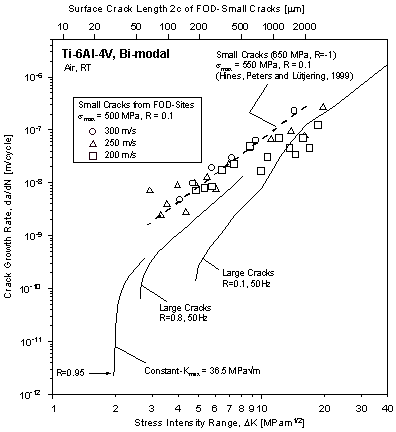
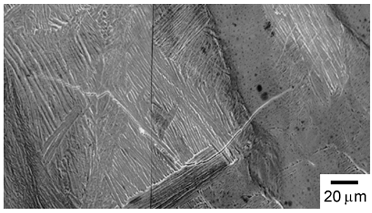
Fig. 13: Lamellar microstructure. Crack initiation site at the specimen
surface for a 200 m/s impact (SEM): smax
= 500 MPa,
R = 0.1, 20 Hz.
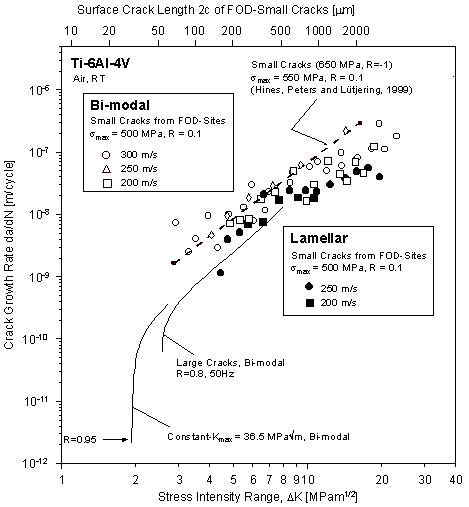
Fig. 14: Fatigue crack propagation behavior of small cracks emanating
from simulated FOD sites. Comparison of bi-modal and
lamellar microstructures.