Microstructural Effects on Small-Crack Propagation
in Ti-6Al-4V under High-Cycle Fatigue Conditions
Mr. J.P. Campbell*,
Dr. A.W. Thompson, Prof.
R.O. Ritchie
University of California, Berkeley
Department of Materials
Science and Mineral Engineering
Berkeley, CA 94720-1760
Dr. D.L. Davidson
Southwest Research Institute
P.O. Box 28510
San Antonio, TX 78238-5166
Although the high cycle fatigue (HCF) loading conditions experienced
in gas-turbine engines are characterized by low stress amplitudes and long
fatigue lives in terms of number of cycles (i.e. > 109),
such failures in engine components involve extremely high cyclic loading
frequencies (1 kHz or greater), such that fatigue lives are very short
in terms of time to failure. The situation is further complicated
by complex loading conditions, including varying degrees of mode-mixity,
high mean stresses, and superimposed HCF and LCF (low cycle fatigue) spectra,
as well as the presence of surface conditions which are believed to hasten
crack initiation, including foreign object damage (FOD) and fretting. Accordingly,
for life prediction and design procedures, it is necessary to characterize
the critical states of microstructural and geometric damage that will lead
to crack initiation, growth, and failure by HCF. One approach to such a
characterization is the definition of lower-bound thresholds for fatigue
crack propagation.
Damage tolerant approaches to fatigue design commonly employ crack propagation
rates measured for long cracks (e.g., crack size, a > 5 mm). Given
the widely reported disparity between long and small (a < 0.5
- 1.0 mm) fatigue cracks [1-4], this approach must be deemed non-conservative.
Indeed, a pronounced small-crack effect has been observed in Ti-6Al-4V
(wt. %) with a variety of microstructures, with small cracks exhibiting
i) faster propagation rates than long cracks at equivalent DK
and ii) significant crack-growth rates at applied DK
below the long-crack DKTH.
In Figure 1, this point is illustrated using a compilation of literature
data [5-9] for propagation rates of small, semi-elliptical surface cracks
and long, through-thickness cracks in Ti-6Al-4V exhibiting both fully lamellar
and bimodal (equiaxed primary a in a transformed
b matrix) microstructures. In addition to clearly
demonstrating the presence of a small-crack effect, Figure 1 also reveals
that the relative fatigue-crack propagation resistance of these two common
Ti-6Al-4V microstructures is dependent on defect size. In the case of long,
through-thickness cracks, fully lamellar microstructures exhibit superior
cyclic crack growth properties, with higher DKTH
and lower growth rates at equivalent DK
than the bimodal microstructures. Conversely, for small crack sizes (full
surface crack length, 2c ~ 5-500 mm),
the bimodal microstructures are better, with lower growth rates at equivalent
values of DK. Additionally, small crack
propagation rates in the lamellar microstructure exhibit far greater scatter.
Although such small crack behavior has been well documented for constant
amplitude, mode I loading on naturally initiated flaws, a detailed examination
of this behavior is needed under the aforementioned surface and loading
conditions which characterize gas-turbine engine HCF.
Accordingly, in the present work, the initiation and propagation of
small, semi-elliptical surface cracks in Ti-6Al-4V is characterized under
HCF conditions, i.e., at high mean stress (R = 0.8) and high frequencies
(n = 1-2 kHz). Various microstructures are examined,
having been thermo-mechanically processed to achieve varied volume fractions
of primary a while maintaining equivalent a
lath dimensions in the transformed b matrix.
Specifically, microstructures containing primary a
contents of ~50% (STOA), 15%, and 0% (fully lamellar) are investigated.
Thresholds for crack formation, DsTH,
and growth, DKTH, from sites
of surface damage, including cylindrical notches (produced by both traditional
machining and electrical discharge machining), hardness indents, and ion
milled notches, are observed and compared with available fatigue-crack
propagation data for long cracks and naturally initiated small cracks.
The influence of superimposed low mean stress, low frequency loading (i.e.
HCF/LCF interactions) on the threshold conditions for crack initiation
and growth are also observed. In the case of HCF/LCF interactions, a comparison
is made between a loading spectrum in which the minimum applied stresses
remain tensile and a spectrum in which the LCF minimum stress is compressive.
This compression loading is expected to alter crack initiation and growth
conditions by generating residual tensile stresses in the vicinity of notch-like
defects and by suppressing crack closure effects.
Acknowledgments
This work was funded by the U.S. Air Force Office of Scientific Research
through the Multidisciplinary University Research Initiative on High Cycle
Fatigue, Grant No. F49620-96-1-0478
References
1. S. Suresh and R.O. Ritchie, Int. Metals Rev. 29 (1984),
445.
2. K.J. Miller, Fatigue Engng. Mater. Struct. 5 (1982),
223.
3. R.O. Ritchie and J. Lankford, Mater. Sci. Eng. A84 (1986),
11.
4. J. Lankford, Fatigue Engng. Mater. Struct. 8 (1985),
161.
5. A.W. Thompson, J.C. Williams, J.D. Frandsen, and J.C. Chesnutt in
Titanium and Titanium Alloys: Scientific and Technological Aspects,
ed. J.C. Williams and A.F. Belov, (Plenum Press, 1982), 691.
6. M.D. Halliday and C.J. Beevers, Int. J. Fract. 15 (1979),
R27.
7. G. Lütjering, J. Albrecht, and A. Gysler in Titanium '92:
Science and Technology, ed. F.H. Froes and I. Caplan, (TMS; Warrendale,
PA, 1993), 1635.
8. R.K. Bolingbroke and J.E. King in Small Fatigue Cracks, ed.
R.O. Ritchie and J. Lankford, (TMS; Warrendale, PA, 1986), 129.
9. G. Lütjering, A. Gysler, and L. Wagner in 6th World Conference
on Titanium, (Societé Francaise de Metallurgie, Les Illis, France,
1988), 79.
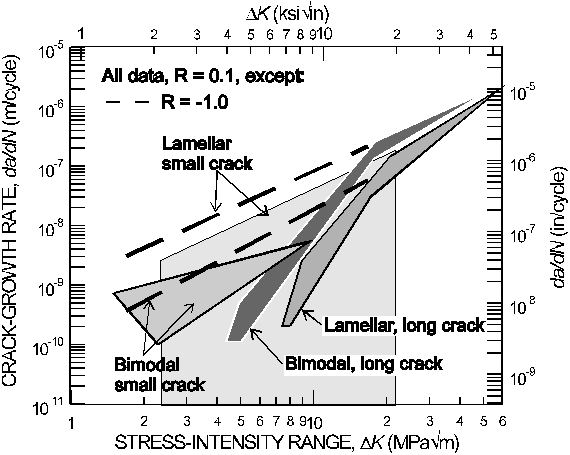
Figure 1: Comparison of literature data on fatigue-crack propagation rates
in bimodal and fully lamellar Ti-6Al-4V for long, through-thickness cracks
and small, naturally initiated surface cracks. All data are acquired at
conventional loading frequencies, i.e., n <
100 Hz. References: lamellar, long cracks (R=0.1), [5,6]; bimodal,
long cracks (R = 0.1), [5,7]; bimodal and lamellar small cracks,
shaded scatter bands (R = 0.1), [8]; bimodal and lamellar small
cracks, dashed line (R = -1.0), [9].