

The Proposed Facility
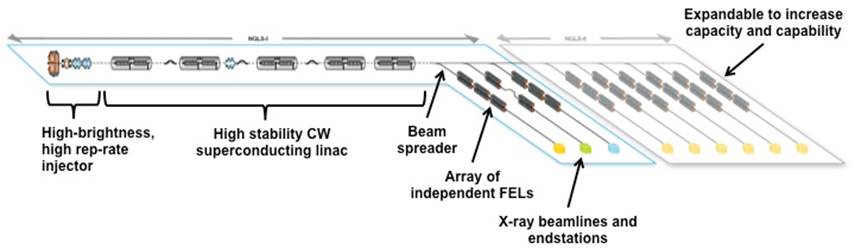
Schematic layout of the main components of NGLS (not to scale), showing the phased approach and major components
The NGLS is planned to be a multiple-beam X-ray laser. It uses a high-current superconducting electron accelerator to produce a train of electron bunches (at 1 MHz and ultimately significantly higher repetition rates), which are sequentially fed to multiple undulators, which generate independent, simultaneous X-ray laser beams for end-station instruments serving multiple users. Generally, X-ray free-electron lasers (FELs) today (LCLS, SACLA, FERMI@elettra) and those under construction (Pohang FEL, SwissFEL) are based on copper linacs. These operate at very low (<1%) duty factors due to the resistive losses. The FEL in Hamburg (FLASH) and the European XFEL (under construction) use superconducting linacs, but also operate at low-duty factors to achieve higher electron energies. The NGLS would be unique in employing a continuous wave (CW) superconducting linac that, together with a programmable beam spreader, would allow a highly flexible distribution of electron bunches into a variety of simultaneously operating FELs.
The NGLS approach combines significant recent advances in high-brightness photocathode beam generation, acceleration, and transport with state-of-the-art superconducting radio-frequency accelerator technology, as well as revolutionary concepts for laser-seeded FEL operation and undulator design. The uniform pulse spacing at a high repetition rate will provide unprecedented capabilities at start-up, accommodating more diverse and challenging experiments than those enabled by current or planned sources. The distributed multibeam approach leads to enhanced capacity by expanding the number of end stations. There also is tremendous opportunity to exploit advances in machine control and operation to provide greater flexibility and new capabilities for generating X-ray pulses tailored to specific science needs. The high repetition rate allows the use of beam-based feedback in order to approach the stability achieved by storage rings.
To be cost-effective and take advantage of advances in technology and understanding, NGLS construction will be phased and will accommodate modular additional FEL beamlines. NGLS-I includes the superconducting linac, along with three initial FELs. NGLS-II adds capacity and capability, with additional FEL beamlines driven by the linac.
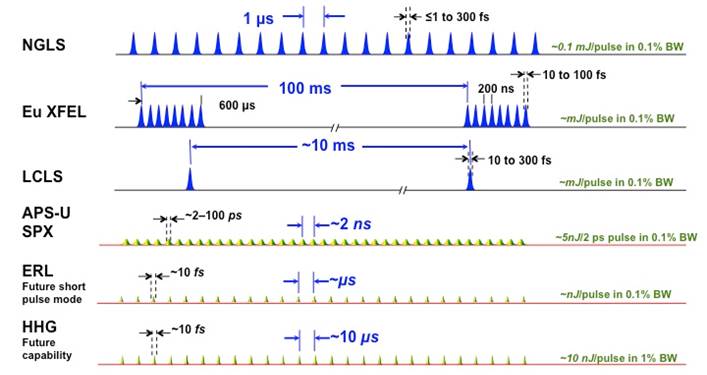
Comparison of coherent pulse characteristics of existing and planned light sources. No other technology can provide the average power, precision, and simultaneous utilization of multiple beams by many researchers. First-generation X-ray FELs with low repetition rates provide orders-of-magnitude improvement over existing sources, primarily in peak brightness and temporal resolution. However, peak brightness is not a substitute for average brightness, particularly when probing valence electron structure, chemical bonding, electron correlation, and charge dynamics in condensed matter systems.

