 |
Recent Publications
Bissell MJ, Radisky D. Putting tumours
in context.
Nat
Rev Cancer. 2001 Oct;1(1):46-54.
Radisky D, Muschler J, Bissell MJ. Order and disorder: the role of extracellular matrix in epithelial cancer. Cancer Invest. 2002;20(1):139-53
Sternlicht MD, Bissell MJ, Werb Z. The matrix metalloproteinase stromelysin-1 acts as a natural mammary tumor promoter. Oncogene. 2000 Feb 21;19(8):1102-13.
Lochter A, Werb Z, Bissell
MJ. Transcriptional regulation of stromelysin-1 gene expression is altered
during progression of mouse mammary epithelial cells from functionally
normal to malignant. Matrix
Biol. 1999 Oct;18(5):455-67.
Sternlicht MD, Lochter A,
Sympson CJ, Huey B, Rougier JP, Gray JW, Pinkel D, Bissell MJ, Werb Z.
The stromal proteinase MMP3/stromelysin-1 promotes mammary carcinogenesis.
Cell.
1999 Jul 23;98(2):137-46.
While normal stroma can delay or prevent tumorigenesis, abnormal stromal components can promote tumor growth. Acquired or inherited mutations that alter stromal cell function can release the context-suppressed malignant cells. Literature spanning more than a century has shown that inflammation associated with tissue wounding can produce tumours.
Matrix metalloproteinases
(MMPs) can degrade ECM and are involved in promoting the inflammatory
response, normal tissue remodelling, wound healing and angiogenesis. These
enzymes also play an important role in malignancy, however. The sustained
presence of these proteases in the tumor environment, produced both by
the activated cells and by the cancer cells themselves, leads to destruction
of normal ECM. Degradation of ECM stimulates both proliferative and apoptotic
mechanisms, which can lead to the selection of apoptosis-resistant carcinoma
cells and enhanced invasive potential. In the tumor context, direct association
of MMPs with specific ECM receptors provides spatial control of MMP activity
and directional signals to the invading tumor cells44.
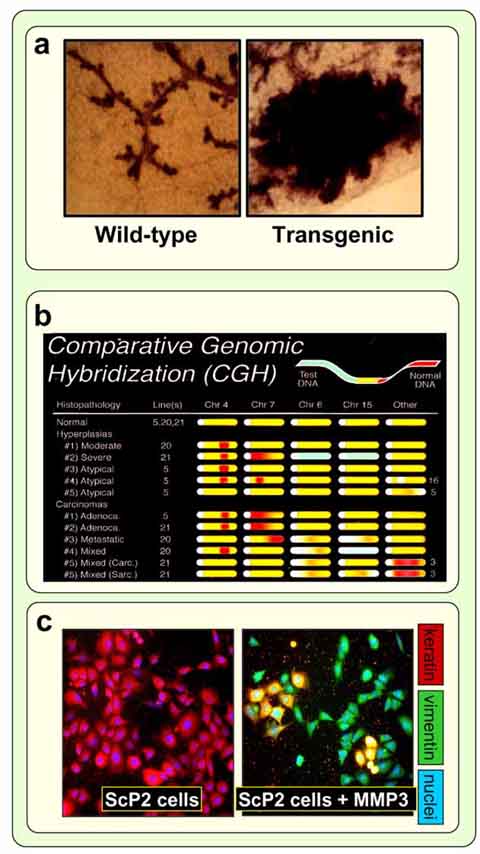
Stromelysin-1 (SL-1, also known as MMP-3), is an MMP that is involved
in both mammary gland development and breast cancer. In transgenic mice
that express SL-1 in mammary luminal epithelial cells (WAP-SL-1), the
mammary glands show morphogenesis defects and contain pre-neoplastic lesions
that eventually lead to full malignancies (Figure a). Here, the causative
mechanism appears to be that SL-1 — expressed ectopically at low
levels in the epithelial cells — is subsequently produced at much
higher levels by the stromal fibroblasts, showing that a moderate disruption
contributes to a self-sustaining tumorigenic state. Similar reciprocal
feedback mechanisms have been observed in transgenic mice with altered
expression of MMP-7, MMP-11, and MT1-MMP. CGH analysis of tumors from
different WAP-SL-1 transgenic mice revealed common patterns of genomic
rearrangements (Figure b), showing that extracellular SL-1 could directly
act to induce gennomic instability. Experiments using cultured cells have
shown that cellular context determines the response of mammary epithelial
cells to SL-1 treatment: when grown in basement membrane gels, mammary
epithelial cells undergo growth arrest and become functionally differentiated;
subsequent treatment of these cells with SL-1 causes apoptosis47. However,
when cultured on two-dimensional matrices and allowed to continuously
proliferate, mammary epithelial cells react to treatment with SL-1 by
undergoing an epithelial–mesenchymal transition (Figure c) and becoming
tumorigenic. Current experiments suggest that SL-1-mediated conversion
to the mesenchymal phenotypic is accompanied by acquisition of genomic
instability, and the underlying mechanism is a current topic of investigation.