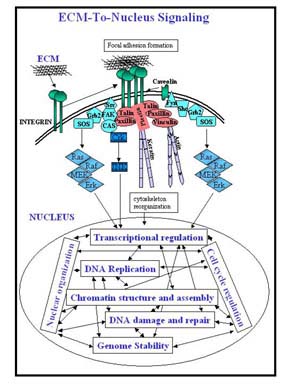
Effects of ECM on DNA repair, transcription, and transcriptional regulation of DNA repair
Determining how ECM-initiated signals converge on nuclear processes such as DNA repair and transcription is our main goal. We have used two separate but intersecting approaches. First, we have developed breast epithelial cell lines containing substrates that allow a fluorescent readout for measuring double-strand break repair (DSBR) and loss-of-function mutation frequencies. We are now asking how ECM signals affect DSBR and mutagenesis in tissue culture models. In addition, we determined global mRNA expression pattern changes observed in response to ECM signals. Among the groups of genes that show altered mRNA levels, we found many DNA repair genes and are pursuing the relevance of these mRNA changes to the effects we observe in the functional assays. Our future goals include determining ECM effects on DNA repair and mutagenesis in mouse models in vivo.
Recent Publications: Bissell MJ, Rizki A,
Mian IS.Tissue architecture: the ultimate regulator of breast epithelial
function. Curr
Opin Cell Biol. 2003 Dec; 15(6): 753-62. Bissell MJ, Weaver VM, Lelievre SA, Wang F, Petersen OW, Schmeichel KL.Tissue structure, nuclear organization, and gene expression in normal and malignant breast. Cancer Res. 1999 Apr 1; 59(7 Suppl): 1757-1763s; discussion 1763s-1764s.
|